
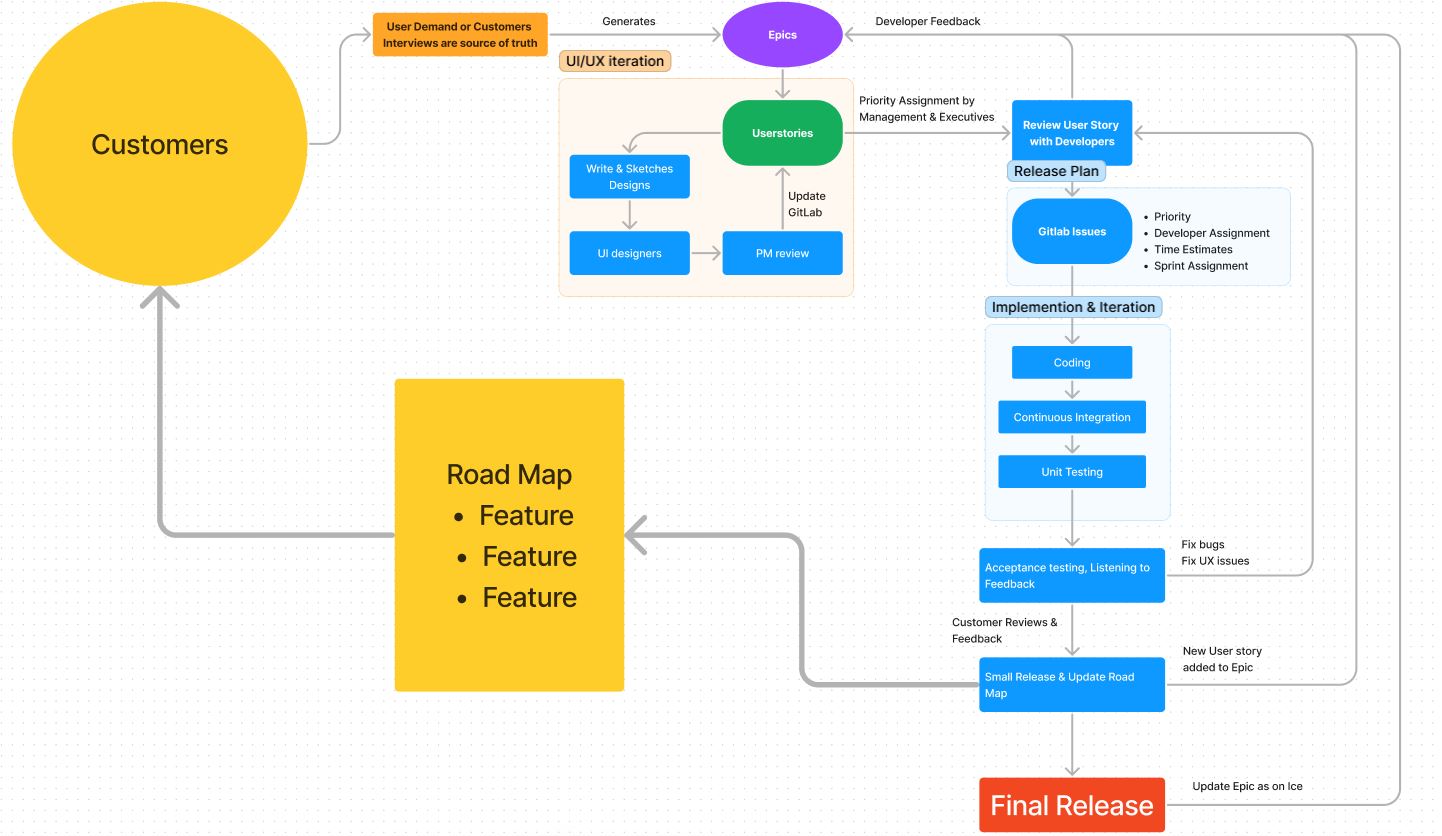
Every day, we start with a quick 10-15 minute team meeting to ensure everyone is aligned and on track. During these meetings, we go over GitLab issues, user stories, and epics. We also review the roadmap, checking with stakeholders to see what’s on the horizon and if we need to rearrange our priorities for any upcoming issues.

Monday – Review Priorities with Executives
New GitLab issues are created every day, ranging from customer bugs to new feature proposals. My job is to sort, prioritize, label, and compile these issues. Once organized, I link them to their respective epics. In our organization, the epic serves as a Product Requirements Document (PRD), detailing the functionality and features we’re working on.
I also make sure any new emails from sales or customer service are compiled into the appropriate epic. This ensures that all feedback and requests are captured and addressed.
Reviewing new feature proposals is another crucial part of my day. I evaluate each proposal, considering its potential impact and alignment with our product strategy.
At the end of the day, I go through user stories, ensuring they are up-to-date and accurately reflect the work that needs to be done. This continuous process helps us stay organized and responsive to both internal and external demands.
Tuesday – Design check-in and more sketching
Tuesdays are all about design. I start the day with a one-on-one meeting with our UI/UX designer to ensure we have all the designs needed for our next meeting tomorrow. This brief review session also provides an opportunity to address any urgent design requests that may have come up.
Next, we focus on user onboarding, ensuring a consistent user experience from the moment a user becomes aware of our brand to when they click the hyperlink. We use GA4 analytics to track user interactions and sign-ups, helping us determine if the benefits of our features are being effectively communicated to customers in real-time.
After that, I dedicate time to a specific design task. This involves writing out all the necessary steps, providing a sketch, and creating a set of screenshots related to that sketch. When writing user stories, I always aim to answer the question, “What is the benefit of this to the user?”
I then outline the steps involved in the user story, similar to storyboarding the user or “imaginary audience” experience. This process helps ensure that every aspect of the user journey is thoughtfully planned and executed.
This daily responsibility ensures that a design is completed every week and is ready for implementation, preventing any downtime and keeping our development process on track.

Every week, I make sure to generate an epic or a user story, depending on our organization’s structure. I write the feature, sketch the designs, and hand those designs to our UI designers. As the Product Manager, I review these designs and decide if they are detailed enough for a user story that developers can easily understand.
What makes a good Userstory
- Clear benefit
- Easily understood UI
- Easily Understand UX
- Plan as day explanation
- Being Explicit as possible
It’s important to take our time with design. The more you rush or make last-minute designs, the more likely you are to make mistakes. For example, you might forget to include an error message if something breaks for the users. Taking a deliberate and thorough approach helps ensure we catch these details and deliver a smooth user experience.
Wednesday -Designers & Developers Meet
Wednesdays are dedicated to bringing our creative and technical minds together. We start with a meeting that includes the copywriter, UI/UX designer, and front-end developer to review the prototype.
In this initial meeting, we determine if the design is refined enough to be finalized and whether we can move on to another design. After the design is completed, it sits on a waitlist of finished epics (designs) to be later discussed at a meeting with developers. During these developer meetings, the epics are broken down into smaller issues or features for a sprint. A sprint typically spans 2-3 weeks, during which developers are assigned issues that are labeled with priority and estimated completion times for each feature. After the design review meeting, we have a daily stand-up to sync up on ongoing tasks. Post-stand-up, I sit down to work on GitLab issues and focus on epics.
At the end of Wednesdays, I prepare a video that goes over the user story problem to share with the developers. This ensures everyone is on the same page and understands the context and goals of the user stories we’re working on.
This process helps maintain a steady workflow and ensures that designs are ready for implementation without delays, keeping our development process efficient and productive.
Thursday GitLab Management and Sprint Planning
Thursdays are dedicated to our “GitLab Management Issue Sessions” or “Sprint Planning.” During these sessions, we reorganize priorities and assign tasks to developers, determining what we will focus on for the upcoming sprint.
After the planning session, if necessary, I meet with the developers to break down the user story into independent GitLab issues. Sometimes we encounter a missing design or a broken story, which I address on the spot or resolve the next day with our UI designers.
This hands-on approach ensures that all tasks are clearly defined and prioritized, allowing developers to work efficiently during the sprint. It also helps us quickly address any gaps or issues in our planning, maintaining a smooth and productive workflow.

Friday – Brainstorming
Fridays are dedicated to creativity and strategic thinking. We start with another UI/UX meeting to review any updates to the design. During this meeting, I provide our UI designer with the next set of incoming designs, ensuring developers have the necessary designs to complete their implementations.
Afterward, we hold a brainstorming session. Some problems in software application development are so complex that they require what I and other PMs call “Design Discussions.” These discussions often last for a few hours. Unlike “Business As Usual” discussions, where ideas are cut short and meetings are rushed, these in-depth discussions allow us to delve into the intricacies of user problems, technical challenges, and design issues.
During these sessions, we take the time to make well-thought-out decisions and critically evaluate what we plan to implement for users. We ensure that our solutions are both user-friendly and technically feasible, aiming to deliver features that truly solve the problems at hand.
These thorough discussions are crucial for developing robust and effective solutions, ensuring that we are not just delivering quick fixes but are addressing the root causes of issues.
Final Takeaways
This 1 week sprint was a method I used in the early days to get CoBaseKRM off the ground. Managing the product development life cycle involves a series of structured yet flexible processes that ensure efficiency and quality. Each day of the week is dedicated to a specific aspect of product management:
- Mondays: Roadmap reviews and stakeholder alignment.
- Tuesdays: Design refinement.
- Wednesdays: Design and developer collaboration.
- Thursdays: Sprint planning and task prioritization.
- Fridays: In-depth brainstorming and problem-solving.
This structured approach helps us manage priorities, address user needs, and ensure a smooth workflow, enhancing our product’s quality and keeping the team focused on delivering the best solutions.
For more insights on effective team collaboration, I recommend the book Teaming by Amy Edmondson. It offers valuable strategies for dynamic teamwork and continuous improvement in fast-paced environments.